KogniFeed
Conversational Surveys vs Traditional Surveys: Which Wins in 2026?
Conversational surveys & AI moderated interviews vs traditional forms — clear examples, when each wins, and a free way to try chat-style research on KogniFeed.
| Capability | KogniFeed |
|---|---|
| Fully AI-run interviews | Yes |
| Blueprint + editable metrics | Yes |
| CRM + website embed + API | Yes |
| Voice conversations | Yes |
| Free tier | 10 sessions / month |
Conversational surveys and AI moderated interviews — quick answer
If you searched for conversational surveys, conversational survey, AI moderated interviews, or conversational interviewing, here is the short version: all four terms describe research that happens as a dialogue, not a static form. A conversational survey is one chat-style session. Conversational surveys are the method at scale. AI moderated interviews add an agent that probes vague answers, stays within guardrails, and fills structured blueprint fields while the conversation runs. Traditional surveys still win when you only need a fast, identical score from thousands of people.
Two formats, two research goals
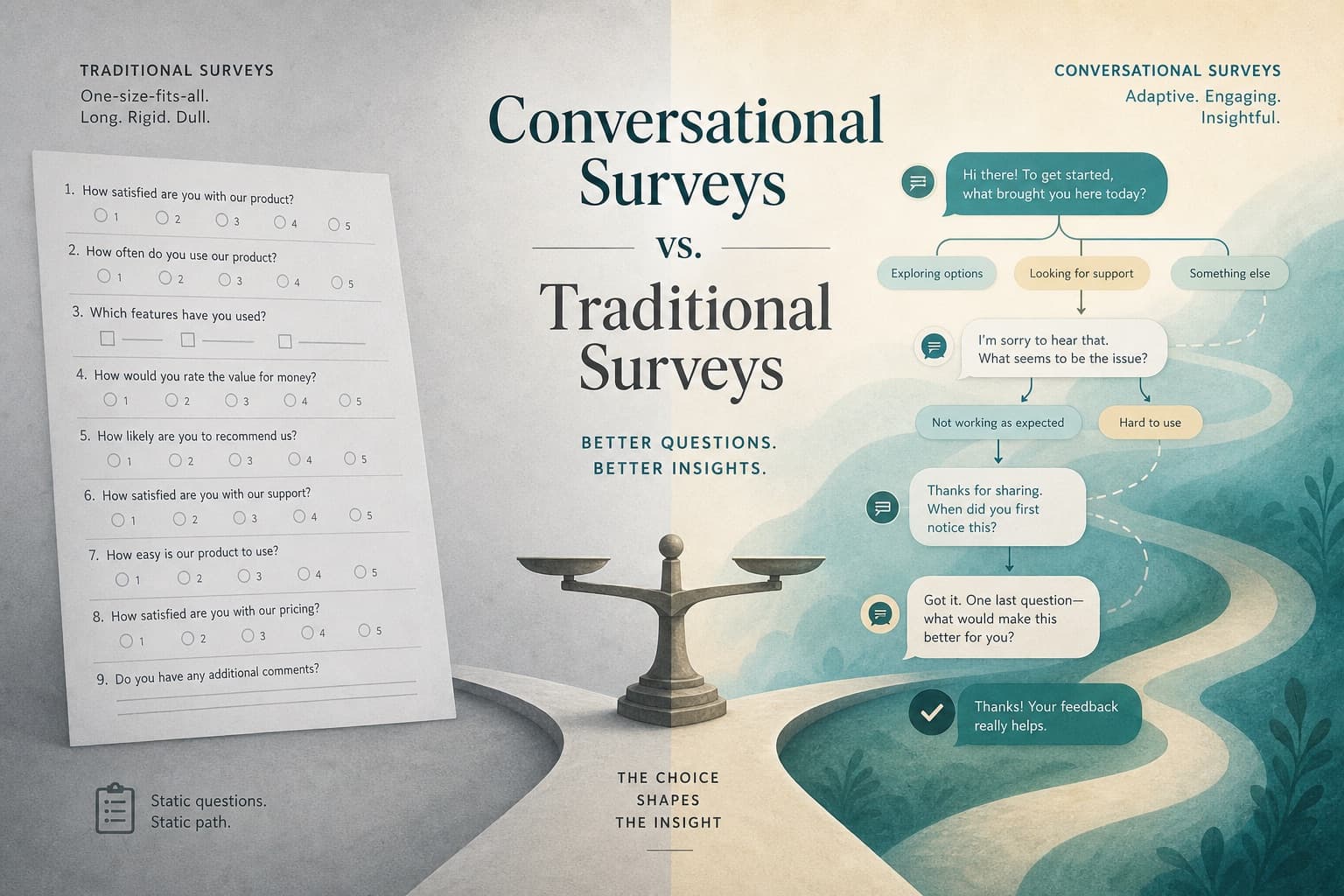
Product and research teams often ask whether to send a traditional online survey or a conversational survey. The honest answer is that they solve different problems. Traditional surveys excel when you need a single comparable number from thousands of people in minutes. Conversational surveys — sometimes labeled AI moderated interviews, adaptive interviews, or chat-based surveys — excel when you need explained answers: the language, context, and reasoning behind a score, a churn signal, or a UX friction moment.
KogniFeed is built for teams that need both modes. Classic surveys handle fixed question flows and benchmark trackers. The Insight agent runs conversational interviews that follow objectives you approve, ask follow-ups when answers are vague, and fill blueprint fields during chat so analysis still includes charts and cohort slices.
What is a traditional survey?
A traditional survey — also called a static form, online questionnaire, or checkbox survey — presents a fixed list of questions in a fixed order. Every participant sees the same flow. That consistency is valuable for NPS trackers, compliance-friendly forms, employee pulse checks, and any study where benchmarking depends on identical wording.
- Best for: high-volume metrics, strict question order, sub-thirty-second completion
- Typical tools: Typeform, Google Forms, SurveyMonkey, Qualtrics-style form builders
- Output: aggregate counts, score distributions, exportable CSV columns
- Weak spot: open-ended text fields that participants rush through or leave blank
What are conversational surveys?
Conversational surveys are research studies where each participant completes a chat-style session instead of clicking through a fixed multi-page form. A single conversational survey might run after checkout, on a pricing page, or as an async user-research wave. The format is mobile-friendly, one topic at a time, and designed so people explain experiences in their own words rather than picking “other” from a dropdown.
What is a conversational survey?
A conversational survey replaces — or wraps — a rigid questionnaire with a chat-style session led by an AI moderator. Instead of showing ten questions at once, the agent asks one topic at a time, listens to the answer, and decides whether to probe deeper, clarify a misunderstanding, or move on. The experience feels closer to a messaging app than a standardized test, which is why mobile-first conversational formats often see higher completion on longer studies.
- Also called: AI moderated interview, adaptive interview, chat survey, conversational interview platform session
- Best for: customer feedback drivers, user research at scale, post-interaction CSAT with context, website pulse widgets
- Output: session transcripts, structured blueprint fields, AI-generated analyst notes, sentiment tags, theme clusters
- Weak spot: not ideal when you need identical question order for strict year-over-year benchmarking
What are AI moderated interviews?
AI moderated interviews — sometimes written AI-moderated interviews — are conversational surveys led by an Insight agent. The agent follows objectives and a blueprint you approve, asks follow-ups when answers are shallow, and produces structured analyst notes when each session ends. They scale qualitative depth the way live moderators do, without scheduling calls across time zones. For a deeper definition, see our guide: What is an AI-moderated interview?
Conversational interviewing: how the dialogue adapts
Conversational interviewing is the practice of moderating research as a back-and-forth dialogue. Unlike a script read aloud, the interviewer — human or AI — listens, clarifies, and decides what to ask next. In KogniFeed, conversational interviewing means the Insight agent can probe a vague NPS detractor score, ask for a screen example on a UX complaint, or skip topics that do not apply to that participant. That adaptability is why conversational interviewing produces richer open-ended data than a static “tell us more” box at the bottom of a form.
Side-by-side comparison
- Question flow — Traditional: fixed order for every participant. Conversational: adaptive follow-ups based on each answer.
- Time to complete — Traditional: often under a minute for score-only forms. Conversational: typically three to seven minutes when you need explained drivers.
- Open-ended quality — Traditional: one-line “fine” or empty boxes. Conversational: agent prompts for examples, specifics, and emotional context.
- Structured metrics — Traditional: native. Conversational: captured via blueprint fields (NPS, CSAT, ratings) filled during chat.
- Scale — Traditional: unlimited respondents, minimal per-response cost. Conversational: async sessions across time zones without scheduling live calls.
- Analysis — Traditional: charts and exports. Conversational: charts plus per-session transcripts, notes, themes, and quotable evidence.
- Distribution — Traditional: email links and embeds. Conversational: same — branded links, CRM invites, website feedback widget, REST API.
Traditional surveys win when…
- You need a single metric from thousands of respondents in minutes — for example a quarterly NPS tracker or a post-event satisfaction score
- Question order must stay identical for strict benchmarking across quarters or regions
- Participants will not spend more than thirty seconds, and a one-click rating is enough
- Regulatory or compliance workflows require a fixed, auditable question list
- You are running a repeatable classic survey inside KogniFeed and already have export-ready analysis for that format
Conversational interviews win when…
- You need to know why a score moved, why churn risk spiked, or why a checkout flow failed — not just that it happened
- Open text boxes on your current form usually return “fine”, “other”, or a single emoji
- Research goals should shift slightly based on what each participant says — for example probing pricing confusion only when price comes up
- You want qualitative research at scale without booking dozens of live Zoom interviews across time zones
- Customer feedback should happen in context — on a pricing page, after support, or right after onboarding — via a website feedback widget or personalized CRM link
- Product readouts need quotable evidence: verbatim quotes, theme clusters, and sentiment slices your stakeholders can act on
Why static open-text fields underperform
Most traditional surveys include at least one “anything else?” box. In practice, response quality drops sharply after the third closed question: participants are tired, typing on mobile is friction, and there is no one to ask “can you give an example?” Industry research consistently shows that adaptive conversational formats retain more respondents per additional question than static multi-page forms, and that AI-moderated open responses carry more specific vocabulary and argumentative depth than the same prompt on a blank text field.
That gap matters for SEO and content strategy too. People do not write paragraphs in survey boxes — they write keywords. Conversational sessions capture how customers actually describe problems, objections, and alternatives. Those phrases feed landing pages, help docs, and positioning copy that mirrors real search language rather than internal jargon.
How adaptive follow-ups work in KogniFeed
In KogniFeed, you start by defining objectives — what you want to learn about onboarding, post-purchase satisfaction, UX friction, or churn risk. The AI builder drafts a blueprint: primary goals, guardrails, and optional structured fields. When a participant opens the session, the Insight agent moderates the conversation within that plan.
- Shallow answer → agent asks for a concrete example or timeline
- Vague complaint → agent narrows to a screen, step, or feature
- Off-topic tangent → guardrails redirect without breaking rapport
- Sensitive area → prohibited topics stay out of the flow you approved
- Structured need → blueprint fields (rating, NPS-style score, multiple choice) fill naturally during chat
You remain in control: researchers review and edit the blueprint before publish, brand the participant experience, and interpret analysis. The agent moderates; you set the research intent.
Blueprint fields: depth without losing charts
A common misconception is that conversational surveys only produce unstructured text. KogniFeed blueprint fields capture structured data during the chat — satisfaction scores, segment tags, feature mentions, device context — so the analysis hub still shows KPI cards, period comparisons, and CRM cohort slices. You get qualitative depth and quantitative roll-ups in one pipeline, not a trade-off between transcripts and spreadsheets.
Hybrid patterns that work in practice
The highest-performing teams rarely choose one format forever. They combine a fast metric with an optional conversational path for people who want to explain.
- NPS or CSAT score first, then an optional “tell us more” conversational link for detractors and passives
- Classic survey for quarterly benchmarking, Insight agent study for quarterly deep-dive on the same customer segment
- Website feedback widget on pricing or checkout — short pulse that can escalate into a longer chat when friction is reported
- CRM-triggered invite after support resolution: one structured satisfaction field plus adaptive follow-up on what would have helped
- Post-onboarding check-in at day seven: conversational session that fills blueprint fields your success team tracks in analysis
Because KogniFeed hosts classic surveys and Insight agent studies in the same admin — with shared projects, CRM contacts, and analysis hub — you do not need separate tools for the score and the story behind it.
Distribution: links, CRM, embed, and API
Conversational research only works if it reaches people where they already are. KogniFeed supports the same distribution patterns as traditional survey tools, applied to Insight agent sessions:
- Branded public links for email campaigns, in-app banners, or QR codes
- CRM segments with personalized invite URLs and bulk sends — up to 500 contacts per account
- Website feedback widget with allowed-origin policies, custom launcher CSS selectors, and branded appearance
- REST API for backend-triggered invites after checkout, ticket close, or trial day N
- Projects to organize studies by initiative — onboarding, churn prevention, website pulse — with shared company and product context
Analysis: counts vs explained evidence
Static forms aggregate counts: how many chose “very dissatisfied”, how NPS moved quarter over quarter. That is essential reporting. Conversational platforms add a participant-level layer that product and research teams actually use in readouts.
- Full session transcripts with searchable verbatim quotes
- AI-generated structured analyst notes after each session completes
- Sentiment tagging — positive, neutral, negative — across themes
- Automatic topic clustering and canonical themes so patterns emerge without manual coding marathons
- Cohort, period, and CRM segment compare to see whether drivers differ by plan, region, or lifecycle stage
- Email digest when post-interview analysis finishes so stakeholders do not poll a dashboard
The outcome is a product summary that includes both the chart and the quote that explains the chart — the combination executives and designers ask for after every NPS drop.
Use cases where conversational beats traditional
- User research — async discovery interviews with dozens of participants; agent probes jobs-to-be-done without a researcher on every call
- Customer feedback — replace one-line “how was your experience?” boxes with sessions that capture drivers and competitive mentions
- Post-interaction CSAT — after payment, delivery, or support, ask what almost went wrong and show context assets inside chat when participants get stuck
- Website pulse — embed feedback on pricing, docs, or onboarding pages; learn what confused visitors before they bounce
- Relationship and churn pulses — NPS-style health checks where passives and detractors get adaptive follow-up on renewal risk
- Onboarding check-ins — day-three or day-seven conversations that reveal setup blockers your analytics funnel cannot see
When to keep a traditional survey instead
Conversational surveys are not a replacement for every questionnaire. Keep a traditional format when legal requires fixed wording, when you are running a high-frequency one-question tracker, or when leadership only needs a number this week. KogniFeed classic surveys cover that path with AI-assisted question design, branded public forms, and export-ready analysis — in the same workspace as your Insight agent studies.
A simple decision guide
- Ask “what number moved?” → start with a traditional or blueprint score field
- Ask “why did it move?” → add a conversational follow-up or run an Insight agent study
- Ask “what should we build next?” → conversational user research with blueprint tags for prioritization
- Ask “is this page confusing?” → website feedback widget with in-context chat
- Ask “are we comparable to last quarter?” → classic survey with identical question order
- Ask “what would customers tell a friend?” → conversational session; captures natural language for marketing and SEO
Getting started on KogniFeed
If conversational surveys vs traditional surveys is the question, the practical next step is to run one small study of each on the same topic — for example post-purchase satisfaction — and compare open-text quality side by side. KogniFeed free tier includes monthly Insight sessions, classic survey builder, CRM contacts, and the analysis hub so you can validate adaptive AI interviews before upgrading for volume.
Start from a built-in template — onboarding, NPS, churn risk, website embed, post-purchase CSAT — or describe what you need to learn and let the AI builder propose objectives and a blueprint you edit before publish. Whether you share a branded link, invite a CRM segment, or embed a website feedback widget, the same analysis pipeline turns conversations into notes, themes, and structured fields your team can act on.
Frequently asked questions
What are conversational surveys?
Conversational surveys are research studies where participants answer through chat-style dialogue instead of a fixed multi-page form. Each conversational survey session adapts follow-ups based on what the person says, which produces deeper open-ended answers than static text boxes.
What are AI moderated interviews?
AI moderated interviews — sometimes written AI-moderated interviews — are conversational surveys led by an Insight agent. The agent follows your objectives and blueprint, asks probing follow-ups, captures structured fields during chat, and generates analyst notes and transcripts after each session.
What is conversational interviewing?
Conversational interviewing is moderating research as adaptive dialogue rather than a fixed script. The moderator — human or AI — clarifies vague answers, asks for examples, and skips irrelevant topics, which improves open-ended response quality compared to traditional survey forms.
How can I try AI moderated interviews?
Sign up for KogniFeed free — 10 Insight sessions per month, no credit card required. Choose a template, edit the blueprint, and run a conversational survey via branded link, CRM invite, or website embed. Classic surveys and analysis are included.
What is the difference between conversational surveys and traditional surveys?
Traditional surveys show every participant the same fixed questions in the same order, optimized for fast metrics like NPS or CSAT. Conversational surveys use an AI moderator to ask adaptive follow-ups in a chat-style session, capturing explained answers and structured blueprint fields without losing charts or exports.
When should I use a conversational survey instead of a form?
Use a conversational survey when you need to know why a score changed, why users churn, or what caused UX friction — not just the number. They work well for customer feedback, async user research, post-interaction CSAT, and website pulse widgets when open text boxes on static forms return shallow answers.
Can conversational surveys still produce structured data and charts?
Yes. Platforms like KogniFeed capture blueprint fields — ratings, NPS-style scores, tags — during the chat. The analysis hub shows KPI cards, cohort comparisons, and exports alongside transcripts, AI notes, and theme clusters.
Do I have to replace all my surveys with conversational interviews?
No. Many teams run hybrid workflows: a one-click score question or classic benchmark survey, plus an optional conversational link for detractors and passives. KogniFeed supports both classic surveys and Insight agent studies in the same workspace.
How does KogniFeed distribute conversational surveys?
KogniFeed supports branded public links, CRM segment invites with personalized URLs, a website feedback widget with origin policies and CSS launcher selectors, and REST API triggers for post-checkout or post-support flows.
FAQ
What are conversational surveys?
Conversational surveys are research studies where participants answer through chat-style dialogue instead of a fixed multi-page form. Each conversational survey session adapts follow-ups based on what the person says, which produces deeper open-ended answers than static text boxes.
What are AI moderated interviews?
AI moderated interviews are conversational surveys led by an Insight agent. The agent follows your objectives and blueprint, asks probing follow-ups, captures structured fields during chat, and generates analyst notes and transcripts after each session — scaling qualitative research without live moderators.
What is conversational interviewing?
Conversational interviewing is moderating research as adaptive dialogue rather than a fixed script. The moderator — human or AI — clarifies vague answers, asks for examples, and skips irrelevant topics, which improves open-ended response quality compared to traditional survey forms.
How can I try AI moderated interviews?
Sign up for KogniFeed free — 10 Insight sessions per month, no credit card required. Choose a template, edit the blueprint, and run a conversational survey via branded link, CRM invite, or website embed. Classic surveys and analysis are included.
Do I have to replace all my surveys with conversational interviews?
No. Many teams run hybrid workflows: a one-click score question or classic benchmark survey, plus an optional conversational link for detractors and passives. KogniFeed supports both classic surveys and Insight agent studies in the same workspace.
How does KogniFeed distribute conversational surveys?
KogniFeed supports branded public links, CRM segment invites with personalized URLs, a website feedback widget with origin policies and CSS launcher selectors, and REST API triggers for post-checkout or post-support flows.